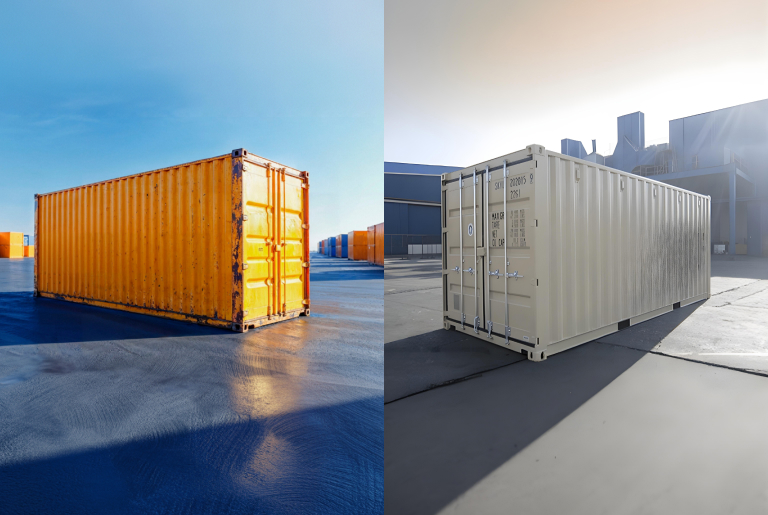
When searching for durable, secure storage solutions for your commercial or industrial operation, you’ve likely encountered two terms that seem interchangeable: shipping containers and conex boxes. While these terms are often used synonymously in the industry, understanding their origins, characteristics, and applications can help you make a more informed purchasing decision for your business needs. Whether you’re looking to expand warehouse capacity, create on-site storage at a construction project, or establish secure inventory management systems, knowing exactly what you’re buying matters.
What are Shipping Containers?
Shipping containers, commonly referred to as storage containers or cargo containers, are standardized steel boxes originally designed for intermodal freight transport. These robust structures were revolutionized in the 1950s by American entrepreneur Malcolm McLean, who developed the modern shipping container system that transformed global commerce. Today, these containers are the backbone of international trade, moving goods across oceans, railways, and highways with remarkable efficiency.
For commercial and industrial businesses, storage containers have evolved far beyond their original maritime purpose. These steel structures are now recognized as versatile, cost-effective solutions for on-site storage, mobile offices, equipment housing, and even modified workspace facilities. The standardization of shipping containers means they come in predictable sizes, most commonly 20-foot and 40-foot lengths, with heights of 8.6 feet for standard containers and 9.6 feet for high-cube variants.
Constructed from corrugated weathering steel (often referred to as corten steel), storage containers are engineered to withstand the harshest conditions imaginable. They’re designed to be stacked when fully loaded and to endure salt water exposure, extreme temperatures, and the constant stress of ocean transport. This inherent durability makes them ideal for businesses requiring secure, weather-resistant storage that can stand up to the demands of construction sites, manufacturing facilities, retail operations, and agricultural enterprises.
Modern storage containers feature cargo doors with heavy-duty locking mechanisms, marine-grade plywood flooring, and ventilation systems. They’re also highly customizable, allowing businesses to add shelving, lighting, climate control, windows, personnel doors, and other modifications to suit specific operational requirements.
What are Conex Boxes?
Conex boxes, while appearing identical to standard shipping containers, carry a distinct historical significance. The term “CONEX” is actually an acronym for “Container Express,” a system developed by the United States Army during the Korean War in the early 1950s. Faced with massive logistical challenges in supplying troops overseas, the military needed a better way to transport equipment, supplies, and materials that wouldn’t be damaged or pilfered during transit.
The original conex boxes were smaller than today’s standard shipping containers, typically measuring 6x6x6 feet or 8x8x6 feet. These military containers solved critical supply chain problems by providing standardized, stackable, secure units that could be easily loaded onto ships, trains, and trucks. The success of the military’s CONEX system actually influenced the development of the civilian shipping container industry, running parallel to McLean’s innovations in commercial shipping.
Today, when people use the term “conex box,” they’re typically referring to the same ISO-standardized shipping containers used in global commerce. However, the military and some government agencies still use actual conex containers that may differ slightly in dimensions and specifications from commercial shipping containers. Additionally, conex boxes sold in the surplus market often come from military or government use and may show different wear patterns or have specific modifications reflecting their previous service.
For industrial and commercial buyers, the term “conex box” has essentially become regional vernacular for shipping containers, particularly in areas with strong military presence or among buyers with military backgrounds. The terminology preference doesn’t typically affect the product itself, as most containers available for purchase meet the same International Organization for Standardization (ISO) specifications.
What is the Difference Between Shipping Containers vs. Conex Boxes?
The honest answer for most commercial buyers is that there is no functional difference between shipping containers and conex boxes in today’s market. Both terms describe the same product: ISO-standardized corrugated steel containers designed for cargo transport and storage. The distinction lies primarily in terminology, historical origin, and occasionally in regional preference.
The confusion arises from the parallel development of military and civilian container systems in the 1950s. While the military developed the conex system for its specific logistics needs, the regular shipping industry was simultaneously creating what would become the modern intermodal shipping container. Over time, these systems converged on similar standards, and today’s containers meet ISO specifications that ensure global compatibility.
When you encounter “storage containers for sale New Jersey” or similar listings, you’ll find that vendors often use both terms interchangeably in their marketing. A supplier might advertise “conex boxes” and “shipping containers” side by side, referring to the exact same inventory. This reflects customer search habits rather than actual product differences.
For businesses researching options to buy shipping containers New Jersey or searching for New Jersey storage containers for sale, the key is focusing on the container’s condition, specifications, and suitability for your intended use rather than getting caught up in terminology. Whether a vendor calls it a shipping container, conex box, cargo container, or ISO container, what matters is the unit’s structural integrity, size, condition grade (new, one-trip, cargo-worthy, wind and water tight, or as-is), and how well it meets your operational requirements.
Benefits of Shipping Containers and Conex Boxes for Commercial Operations
Regardless of what you call them, shipping containers offer compelling advantages for commercial and industrial businesses that make them superior to traditional storage buildings in many applications.
Durability & Security
Durability and security stand as perhaps the most significant benefits. These containers are constructed to survive decades of harsh maritime conditions, meaning they’ll easily handle whatever your business location throws at them. The corrugated steel construction resists impacts, the weathering steel resists corrosion, and the heavy-duty locking mechanisms provide security that’s difficult and expensive to achieve with conventional structures. For businesses storing valuable inventory, equipment, or materials, this security is invaluable.
Cost-Effectiveness
Shipping containers’ cost-effectiveness makes them attractive for businesses managing budgets carefully. Compared to constructing permanent buildings, purchasing containers delivers similar square footage at a fraction of the cost. There are no foundations to pour, no lengthy construction timelines, and no permitting hassles in many jurisdictions. A container can be delivered and operational within days, not months. Additionally, containers retain resale value well, providing an exit strategy that traditional construction doesn’t offer.
Flexibility and Mobility
Shipping containers give businesses operational advantages that fixed structures cannot match. Need storage at multiple locations? Containers can move with your operations. Seasonal business requiring temporary expansion? Containers can be delivered for peak season and removed when not needed. Construction projects moving to new sites? Your storage, tools, and site office can be relocated with your crew. This mobility transforms how businesses think about space utilization.
Weather Resistance
Weatherproofing is engineered into every container. The sealed construction, raised floors, and roof design ensure contents remain dry and protected from the elements. For businesses in New Jersey, where the weather ranges from humid summers to snowy winters, this all-season protection ensures inventory and equipment remain in prime condition year-round without the ongoing maintenance traditional structures require.
Customization Potential
Modification options allow containers to evolve with your business needs. Basic storage today can become climate-controlled inventory management tomorrow. Simple modifications can add electrical systems, insulation, HVAC, shelving, workbenches, windows, and personnel doors. Some businesses create complete mobile offices, retail pop-ups, or specialized equipment housing. The steel construction provides an excellent foundation for modifications that would be prohibitively expensive in traditional buildings.
Where to Buy Shipping Containers in New Jersey
For commercial and industrial businesses in New Jersey, selecting the right container supplier is as important as choosing the right container. The Garden State’s strategic location along major transportation corridors means access to robust container inventory, but quality, service, and expertise vary significantly among suppliers.
When searching for storage containers for sale New Jersey, prioritize suppliers like Jake Containers, which has extensive commercial experience and understands the specific needs of businesses rather than casual buyers. Look for companies like Jake Containers that offer comprehensive services, including delivery, placement, modifications, and ongoing support. Jake Containers maintains a diverse inventory across all standard sizes and condition grades, ensuring you can find units that match your specifications and budget.
Transportation logistics matter significantly in New Jersey’s densely populated areas. Reliable suppliers like Jake Containers have experience navigating the state’s regulatory environment, understanding delivery restrictions in various municipalities, and coordinating with businesses on timing that minimizes operational disruption. Jake Containers also provides clear information about delivery requirements, such as site access, overhead clearance, and ground conditions.
When evaluating options to buy shipping containers New Jersey, ask about container history and condition grading standards. Reputable companies provide transparent information about whether containers are new, one-trip (used once internationally), cargo-worthy (certified for continued shipping use), or retired from shipping service. Understanding these distinctions helps you balance cost against expected longevity and appearance.
Consider suppliers like Jake Containers, who offer value-added services such as modifications, repairs, and customization. As your business needs evolve, having an established relationship with a supplier who can modify containers or provide additional units streamlines operations. Jake Containers also offers rental options in nearby areas, which can be valuable for businesses with seasonal needs or those wanting to test container storage before committing to purchase.
Location matters for ongoing relationships. While containers can be delivered statewide, choosing suppliers with facilities or yards reasonably near your operations facilitates easier communication, site visits to inspect inventory before purchase, and faster delivery when you need additional units.
Get Your Commercial Storage Solution Today
Whether you call them shipping containers or conex boxes, these versatile steel structures represent one of the most practical, cost-effective storage solutions available for commercial and industrial operations. Their durability, security, and flexibility make them ideal for businesses across manufacturing, construction, retail, agriculture, and countless other industries.
At Jake Containers, we specialize in helping New Jersey businesses find the perfect storage container solutions for their unique operational needs. Our extensive inventory includes containers in all standard sizes and conditions, and our experienced team can guide you through selection, delivery, and customization options that maximize your investment.
Ready to solve your storage challenges? Contact Jake Containers today for a free, no-obligation quote on storage containers for sale in New Jersey. Our team will assess your requirements, recommend the most cost-effective solutions, and provide transparent pricing with no hidden fees. Whether you need a single 20-foot container for equipment storage or multiple 40-foot units for a major facility expansion, we’re here to deliver the quality and service your business deserves.
Don’t let storage limitations hold your business back. Call Jake Containers now and discover why commercial and industrial operations throughout New Jersey trust us for their container needs.