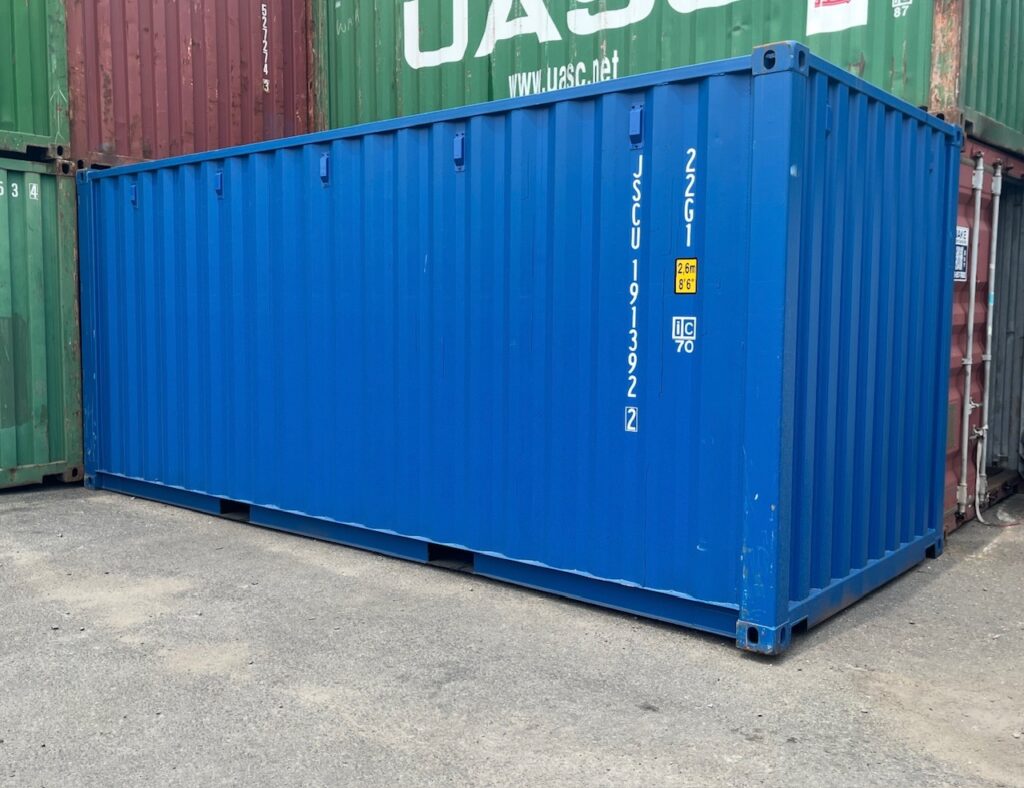
Buying a storage container is one of the most practical investments a business can make. It gives you secure, weatherproof space on your own property, on your own schedule, without the long-term commitment of a warehouse lease or the recurring cost of off-site storage. But the decision is not as simple as picking a size and placing an order. The wrong container can leave you short on space, make loading a daily headache, or create problems with delivery and placement that you did not see coming.
This guide walks through the decision step by step. You will learn how to define what you actually need to store, how the four most common container sizes compare, which features matter most for commercial use, and what to check before you buy. Whether you run a construction company, a retail operation, a manufacturing facility, or a municipal department, the goal is the same: get the right container the first time.
Start With What You Are Storing and Why
Before you look at a single dimension, answer three questions. What is your business storing? How often will you access it? And how long will you need the space?
Inventory, tools, equipment, records, seasonal merchandise, and raw materials all behave differently in storage. Dense, heavy items like tools and building materials call for a container you can load with a forklift or pallet jack. Items you reach for every day need easy access and a clear walkway inside. Items you only touch once a quarter can be packed tightly to the walls.
Think about growth, too. A container that fits today might not as your business grows over the next year or two. Write down your current volume, then add a realistic cushion of 20 to 30 percent. That number becomes your target when you compare sizes below.
Buy or Rent: Which Makes Sense for Your Business?
For most commercial and industrial customers, buying is the stronger long-term choice. A purchased container is an asset on your property, and does not come with monthly rental charges that add up year after year. You can keep it as long as you need it, and it retains resale value if your storage needs change. If your storage needs are ongoing, buying nearly always costs less over time than renting.
Buying also unlocks something rentals cannot offer: modifications. Shelving, electrical wiring, ventilation, lighting, roll-up and personnel doors, branding, and other custom features can be added to purchased containers. Modifications are available on purchased containers only, never on rentals, so if you want a container configured to your exact workflow, purchase is the way to go.
Rentals still have a place. If you need space for a short-term project, a temporary overflow period, or a seasonal surge, renting can be the better fit. Jake Containers offers rentals in New Jersey, while container sales are available across New Jersey, New York, Pennsylvania, and Connecticut. If your timeline is open-ended or you expect to need the space for more than a short project, price out both options before deciding.
Storage Container Sizes Compared
Jake Containers offers four of the most widely used container sizes for business storage: 10-foot, 20-foot, 40-foot, and 40-foot high cube, as well as specialty options like double-door and tri-door. All four share the same exterior width of 8 feet and the same interior width of 7 feet 8 inches. What changes is length, height, capacity, and weight. Here is how each one breaks down.
10-Foot Storage Containers
The 10-foot container is the compact option, built for businesses that need secure storage in a tight footprint.
- Exterior: 10’L x 8’W x 8’6”H
- Interior: 9’4”L x 7’8”W x 7’10”H
- Door opening height: 7’6”H
- Capacity: 680 cubic feet
- Empty weight: 2,450 pounds
With roughly 72 square feet of interior floor space, a 10-foot container works well for tools, small equipment, records, seasonal inventory, and supplies. Its small size makes it the easiest to place. It can fit in tight lots, alongside buildings, or in corners of a property where a larger unit simply will not go. At 2,450 pounds empty, it is also the lightest of the four, which can simplify delivery and placement.
The tradeoff is capacity. If you are storing pallets of inventory or large equipment, you may outgrow a 10-foot container quickly. It is best for businesses with focused, lower-volume storage needs or for a second container dedicated to a specific purpose, like a tool crib or a records room.
20-Foot Storage Containers
The 20-foot container is the most popular size for commercial storage, and for good reason. It balances capacity and footprint better than any other option.
- Exterior: 20’L x 8’W x 8’6”H
- Interior: 19’4”L x 7’8”W x 7’10”H
- Door opening height: 7’6”H
- Capacity: 1,360 cubic feet
- Empty weight: 4,900 pounds
With about 148 square feet of interior floor space and double the capacity of the 10-foot model, the 20-foot container handles a wide range of needs: retail inventory, construction materials, power tools, shop equipment, event supplies, and archived records. It is large enough to hold substantial volume and still small enough that most commercial sites can accommodate it without major site preparation.
If you are unsure which size to choose, the 20-foot container is usually the best starting point. There is enough room to add shelving along one wall and still keep a working aisle.
40-Foot Storage Containers
The 40-foot container is the high-capacity option for operations that need serious volume.
- Exterior: 40’L x 8’W x 8’6”H
- Interior: 39’5”L x 7’8”W x 7’10”H
- Door opening height: 7’6”H
- Capacity: 2,720 cubic feet
- Empty weight: 8,400 pounds
With roughly 302 square feet of interior floor space, a 40-foot container is built for large inventories, bulk materials, long equipment, and high-volume operations. Manufacturers, distributors, contractors, and agricultural businesses often choose this size when they want to consolidate storage into a single unit instead of managing several smaller ones.
The long, narrow shape is worth planning around. You will need enough straight, level space for delivery and placement, plus room for the truck to maneuver. In exchange, you get the most storage on a single footprint.
40-Foot High-Cube Storage Containers
The 40-foot high cube takes everything good about the standard 40-footer and adds a full extra foot of height.
- Exterior: 40’L x 8’W x 9’6”H
- Interior: 39’5”L x 7’8”W x 8’10”H
- Door opening height: 8’6”H
- Capacity: 3,040 cubic feet
- Empty weight: 8,600 pounds
That extra height increases capacity from 2,720 to 3,040 cubic feet, a gain of 320 cubic feet over the standard 40-foot container, and raises the door opening to 8 feet 6 inches. The taller door and ceiling make a real difference when you are storing tall equipment, stacking inventory higher, loading with a forklift, or installing racking and shelving. With an interior height of 8 feet 10 inches, you can also work comfortably inside without ducking.
The high cube is the right pick when vertical space matters. The empty weight is only 200 pounds more than the standard 40-foot container, so the added capacity comes at very little extra weight. Just confirm that your site has the overhead clearance for delivery and placement, since the container stands 9 feet 6 inches tall on the outside.
Quick Comparison
- 10-foot: 680 cubic feet, 2,450 pounds empty, 7’6” door opening
- 20-foot: 1,360 cubic feet, 4,900 pounds empty, 7’6” door opening
- 40-foot: 2,720 cubic feet, 8,400 pounds empty, 7’6” door opening
- 40-foot high cube: 3,040 cubic feet, 8,600 pounds empty, 8’6” door opening
Key Factors to Weigh Before You Buy
Size is the headline, but several other factors determine whether a container works well day to day.
Door Height and Access
The door opening is smaller than the interior, and it is the measurement that decides what can actually go in. All three standard sizes have a 7-foot 6-inch door opening, while the high cube offers 8 feet 6 inches. If you are loading with a forklift, measure your tallest load and compare it to the door opening, not the interior height.
Weight and Site Conditions
Empty weight matters for delivery and placement. A 40-foot container weighs 8,400 pounds before you load anything. The ground beneath it should be level, firm, and well-drained. Many businesses place containers on gravel, asphalt, or concrete pads. Soft or uneven ground can cause a container to shift or its doors to stop closing properly over time. If you are unsure about your site, ask before you order.
Delivery and Placement
Think about how the container will physically arrive. The delivery truck needs a clear path, enough turning radius, and a spot to set the container down. Look up for overhead wires and tree limbs, and look around for gates and tight turns. Jake Containers can deliver in as little as 48 hours, but quick delivery works best when the site is ready.
Local Rules and Permits
Some municipalities regulate where containers can be placed on commercial property. Check with your local zoning or building office before you finalize your order.
Customize Your Container With Modifications
One of the biggest advantages of buying is that your container can be configured to fit your business. Common modifications include shelving, electrical and lighting, roll-up doors, additional doors, ventilation, and custom branding. A contractor might add heavy-duty shelving for tools and parts. A retailer might add lighting and a personnel door for easy daily access. A business that wants its container to double as a branded presence on site can add custom graphics.
Remember that modifications are available on purchased containers only. If you are leaning toward a rental, think about whether your needs may require a modified setup. If they might, buying is likely the better route.
Why Buy From a Local, Family-Owned Supplier?
Not all container suppliers are alike. National chains can be convenient, but they often route you through call centers, quote through layers of middlemen, and treat your order as one of thousands. Jake Containers is different. Founded in 2017 and headquartered in Ridgefield Park, New Jersey, Jake Containers is a family-owned, locally operated company that works directly with business owners.
That difference shows up not just in our attentive customer service, but in the way we do business as a whole. Jake Containers offers 48-hour delivery capability, a price match guarantee, and no hidden fees or cancellation penalties. We also hold an A+ BBB rating, have earned more than 240 five-star reviews, and are a member of the National Portable Storage Association. Our team also brings over 100 combined years of experience to every order, so you get honest guidance on sizing, site setup, and modifications from people who know containers inside and out.
Ready to Choose Your Container?
The right storage container comes down to knowing what you store, how you work, and where the container will sit. Start with your inventory, add a growth cushion, match it to one of the four sizes above, and confirm your site can handle delivery and placement. If you want a second opinion, the Jake Containers team is happy to talk it through.
Call our team at 973-957-7600 to get a quote or get your sales or rental quote online for 10-foot, 20-foot, 40-foot, 40-foot high cube containers, and more.
GET A FREE QUOTE NOWCALL US TODAY
Frequently Asked Questions
What is the most popular storage container size for businesses?
The 20-foot container is the most popular choice for commercial storage. With 1,360 cubic feet of capacity and roughly 148 square feet of interior floor space, it offers a strong balance between how much it holds and how easily it fits on a typical commercial property. It suits retail inventory, construction materials, tools, equipment, and records, and it leaves enough room for shelving. If you are unsure where to start, a 20-foot container is usually a safe bet.
What is the difference between a 40-foot container and a 40-foot high cube?
Both are 40 feet long and 8 feet wide on the outside, but the high cube stands a foot taller. The standard 40-foot container is 8 feet 6 inches high outside with a 7-foot 10-inch interior and a 7-foot 6-inch door opening. The high cube is 9 feet 6 inches high outside with an 8-foot 10-inch interior and an 8-foot 6-inch door opening. That extra height raises capacity from 2,720 to 3,040 cubic feet, which is useful for tall equipment, high stacking, or forklift loading.
How much does an empty storage container weigh?
Empty weight depends on size. A 10-foot container weighs 2,450 pounds, a 20-foot container weighs 4,900 pounds, a standard 40-foot container weighs 8,400 pounds, and a 40-foot high cube weighs 8,600 pounds. These figures are for the container alone, before you add any contents or modifications. Weight matters for delivery, placement, and choosing a stable, level site, so it is worth confirming your site can handle the size you select.
Should my business buy or rent a storage container?
For most commercial and industrial customers with ongoing storage needs, buying is the better long-term value. A purchased container is an asset you own; it avoids recurring monthly charges, and it can be modified to fit your operation. Rentals make sense for short-term projects, temporary overflow, or seasonal needs. Jake Containers sells containers in New Jersey, New York, Pennsylvania, and Connecticut and offers rentals in New Jersey. If you are not sure which fits, the team can help you compare the costs for your situation.
Can I modify a storage container?
Yes, but only if you buy it. Container modifications such as shelving, electrical wiring, lighting, roll-up doors, additional doors, and custom branding are available on purchased containers only, never on rentals. This is one of the strongest reasons to buy if you want a container built around your workflow. Tell the Jake Containers team what you need to store and how you work, and they can recommend the right combination of container size and modifications.
How do I know how much space I need?
Start by listing everything you plan to store and estimating its total volume, then add a cushion of 20-30% for growth and working room. Compare that figure to the container capacities: 680 cubic feet for the 10-foot, 1,360 for the 20-foot, 2,720 for the 40-foot, and 3,040 for the 40-foot high cube. Also leave room for aisles and any shelving. If you are close to the line between two sizes, choosing the larger one usually saves you from buying a second container later.
What kind of ground does a storage container need to sit on?
A storage container should sit on level, firm, well-drained ground. Many businesses use gravel, asphalt, or a concrete pad. Soft, uneven, or poorly drained soil can cause a container to settle or shift over time, which can affect door operation and long-term performance. Longer containers need more consistent support along their length. If you are unsure about your site, ask the Jake Containers team before delivery so you can address any issues up front.
How quickly can a storage container be delivered?
Jake Containers has 48-hour delivery capability, which means that in many cases your container can arrive within two days of your order. Actual timing depends on availability, location, and site readiness. To keep delivery smooth, make sure the truck has a clear path, enough turning room, and a level spot ready for the container. Checking for overhead wires, tight gates, and parked vehicles before delivery can help avoid delays.
Do I need a permit to place a storage container on my business property?
It depends on where you are located. Some municipalities regulate container placement on commercial property through zoning, setback requirements, or time limits, while others have few restrictions. The best approach is to contact your local zoning or building department before you place your order. Jake Containers serves areas across New Jersey, New York, Pennsylvania, and more, and rules can differ by town and county, so a quick call can prevent costly surprises down the line.
Why should I buy from Jake Containers instead of a national chain?
Jake Containers is a family-owned, locally operated company with a team with over 100 years of experience, so you work directly with people who know the products and your market. You also get 48-hour delivery capability, a price match guarantee, and no hidden fees or cancellation penalties. The company holds an A+ BBB rating, more than 200 five-star reviews, and a National Portable Storage Association membership. When you work with us, you get honest advice on sizing, site setup, and modifications.